English · PDF 368
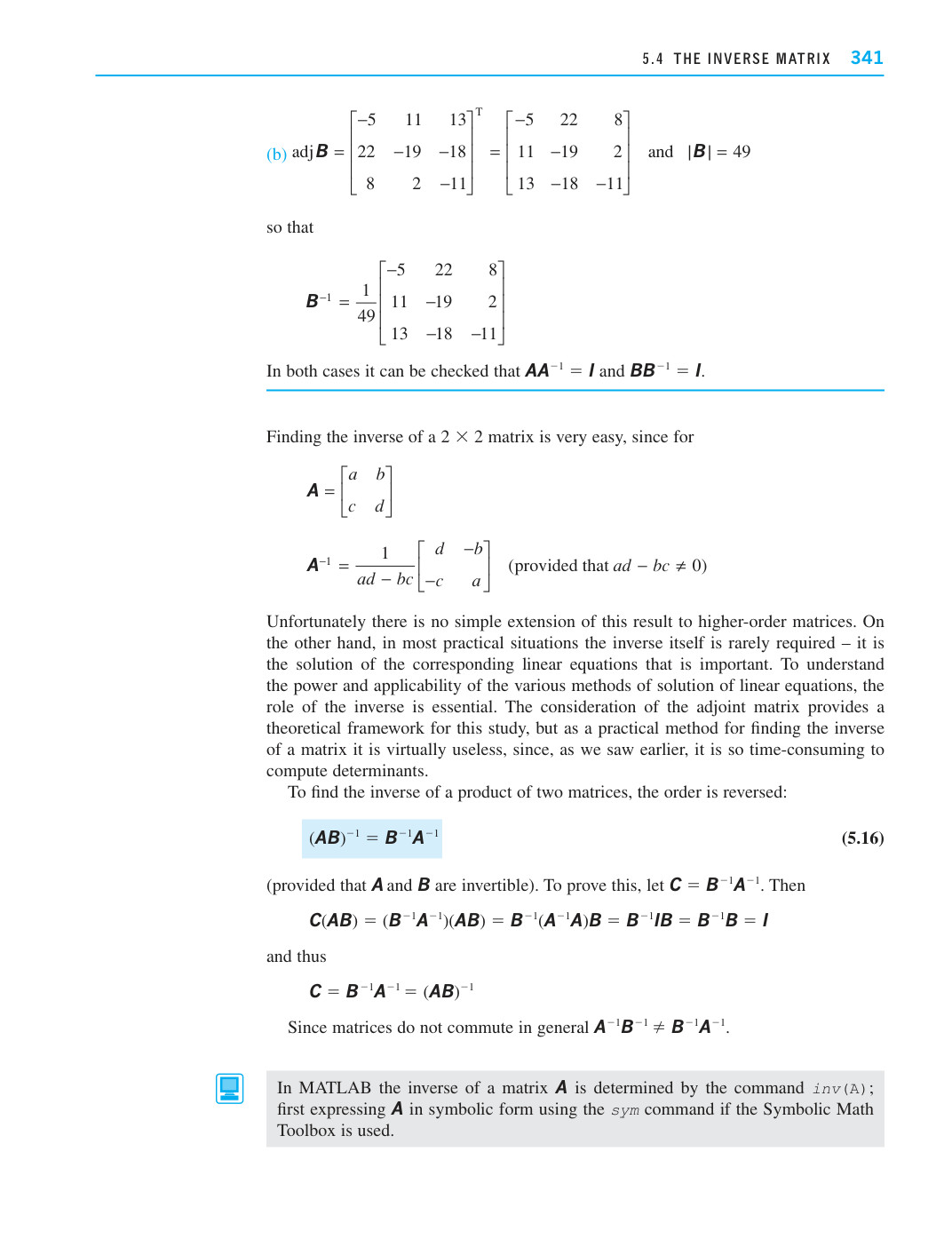
$$(b) \text{adj} \mathbf{B} = \begin{bmatrix} -5 & 11 & 13 \ 22 & -19 & -18 \ 8 & 2 & -11 \end{bmatrix}^T = \begin{bmatrix} -5 & 22 & 8 \ 11 & -19 & 2 \ 13 & -18 & -11 \end{bmatrix} \quad \text{and } |\mathbf{B}| = 49$$
从而
$$\mathbf{B}^{-1} = \frac{1}{49} \begin{bmatrix} -5 & 22 & 8 \ 11 & -19 & 2 \ 13 & -18 & -11 \end{bmatrix}$$
在两种情况下都可以验证 $\mathbf{A}\mathbf{A}^{-1} = \mathbf{I}$ 以及 $\mathbf{B}\mathbf{B}^{-1} = \mathbf{I}$ 。
求 $2 \times 2$ 矩阵的逆非常容易,因为对于
$$\mathbf{A} = \begin{bmatrix} a & b \ c & d \end{bmatrix}$$
$$\mathbf{A}^{-1} = \frac{1}{ad - bc} \begin{bmatrix} d & -b \ -c & a \end{bmatrix} \quad (\text{provided that } ad - bc \neq 0)$$
遗憾的是,这一结果没有简单的推广可以适用于更高阶的矩阵。另一方面,在大多数实际情况下,逆矩阵本身很少被需要——重要的是求解相应的线性方程组。为了理解各种求解线性方程组的方法的威力与适用性,逆矩阵的作用至关重要。对伴随矩阵的考察为这一研究提供了理论框架,但作为求矩阵逆的实际方法,它几乎毫无用处,因为正如我们前面所见,计算行列式非常耗时。
求两个矩阵乘积的逆时,顺序需要颠倒:
$$(\mathbf{A}\mathbf{B})^{-1} = \mathbf{B}^{-1}\mathbf{A}^{-1} \quad (5.16)$$
(前提是 $\mathbf{A}$ 和 $\mathbf{B}$ 可逆)。为证明这一点,设 $\mathbf{C} = \mathbf{B}^{-1}\mathbf{A}^{-1}$ 。则
$$\mathbf{C}(\mathbf{A}\mathbf{B}) = (\mathbf{B}^{-1}\mathbf{A}^{-1})(\mathbf{A}\mathbf{B}) = \mathbf{B}^{-1}(\mathbf{A}^{-1}\mathbf{A})\mathbf{B} = \mathbf{B}^{-1}\mathbf{I}\mathbf{B} = \mathbf{B}^{-1}\mathbf{B} = \mathbf{I}$$
因此
$$\mathbf{C} = \mathbf{B}^{-1}\mathbf{A}^{-1} = (\mathbf{A}\mathbf{B})^{-1}$$
由于矩阵一般不满足交换律 $\mathbf{A}^{-1}\mathbf{B}^{-1} \neq \mathbf{B}^{-1}\mathbf{A}^{-1}$ .

在 MATLAB 中,矩阵的逆 $\mathbf{A}$ 由命令确定 inv(A);首先用 $\mathbf{A}$ 命令将 sym 表示为符号形式(如果使用符号数学工具箱)。