English · PDF 367
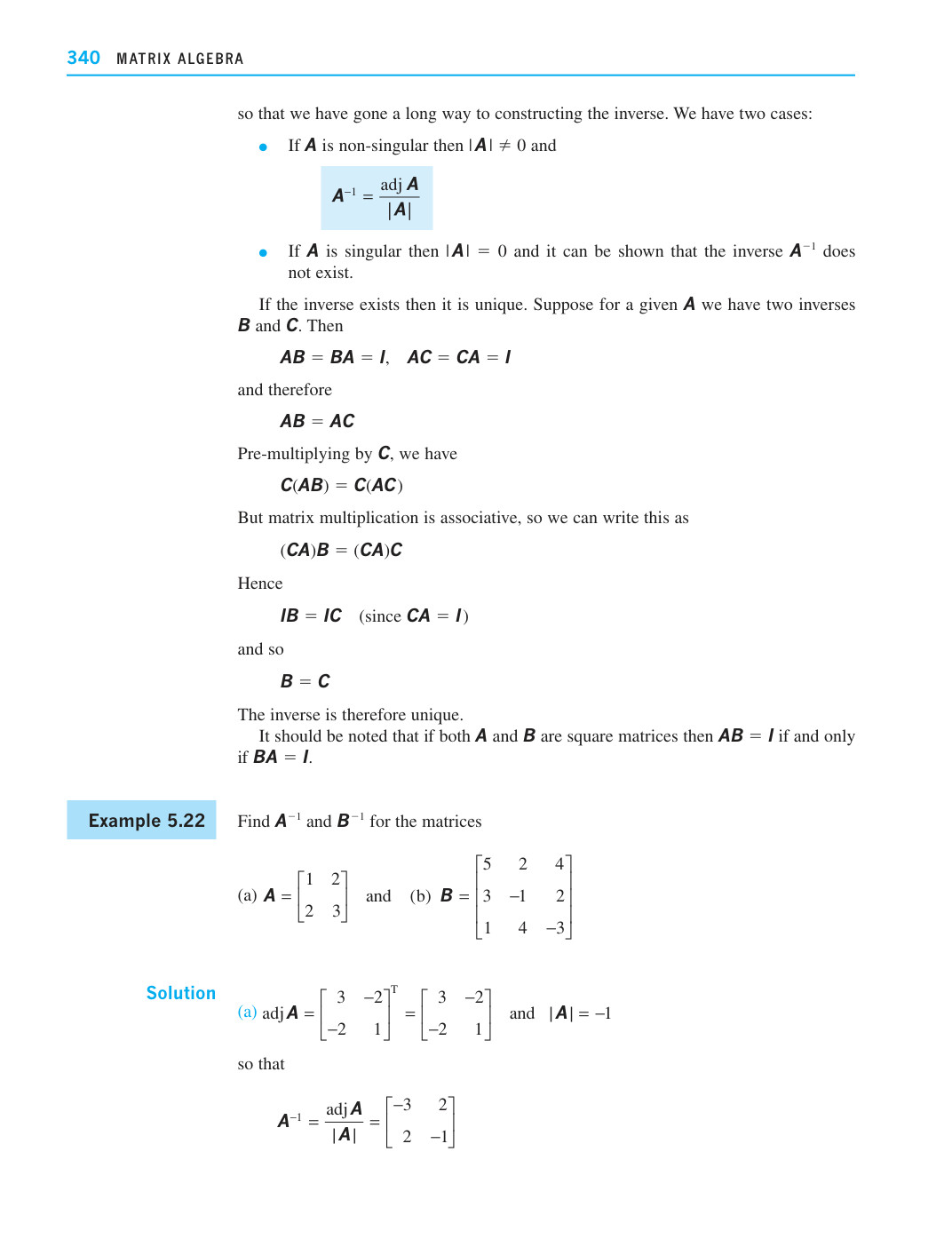
这样我们在构造逆矩阵的路上已经走了很远。我们有两种情况:
$$\mathbf{A}^{-1} = \frac{\text{adj } \mathbf{A}}{|\mathbf{A}|}$$
如果逆矩阵存在,那么它是唯一的。假设对于给定的 $\mathbf{A}$ 我们有两个逆矩阵 $\mathbf{B}$ 和 $\mathbf{C}$ . 那么
$$\mathbf{AB} = \mathbf{BA} = \mathbf{I}, \quad \mathbf{AC} = \mathbf{CA} = \mathbf{I}$$
因此
$$\mathbf{AB} = \mathbf{AC}$$
左乘 $\mathbf{C}$ ,我们得到
$$\mathbf{C}(\mathbf{AB}) = \mathbf{C}(\mathbf{AC})$$
但矩阵乘法满足结合律,所以我们可以将其写为
$$(\mathbf{CA})\mathbf{B} = (\mathbf{CA})\mathbf{C}$$
于是
$$\mathbf{IB} = \mathbf{IC} \quad (\text{since } \mathbf{CA} = \mathbf{I})$$
所以
$$\mathbf{B} = \mathbf{C}$$
因此逆矩阵是唯一的。
应当注意,如果 $\mathbf{A}$ 和 $\mathbf{B}$ 都是方阵,那么 $\mathbf{AB} = \mathbf{I}$ 当且仅当 $\mathbf{BA} = \mathbf{I}$ .
求 $\mathbf{A}^{-1}$ 和 $\mathbf{B}^{-1}$ 对于矩阵
$$(a) \mathbf{A} = \begin{bmatrix} 1 & 2 \ 2 & 3 \end{bmatrix} \quad \text{and} \quad (b) \mathbf{B} = \begin{bmatrix} 5 & 2 & 4 \ 3 & -1 & 2 \ 1 & 4 & -3 \end{bmatrix}$$
$$(a) \text{adj } \mathbf{A} = \begin{bmatrix} 3 & -2 \ -2 & 1 \end{bmatrix}^T = \begin{bmatrix} 3 & -2 \ -2 & 1 \end{bmatrix} \quad \text{and} \quad |\mathbf{A}| = -1$$
使得
$$\mathbf{A}^{-1} = \frac{\text{adj } \mathbf{A}}{|\mathbf{A}|} = \begin{bmatrix} -3 & 2 \ 2 & -1 \end{bmatrix}$$