English · PDF 949
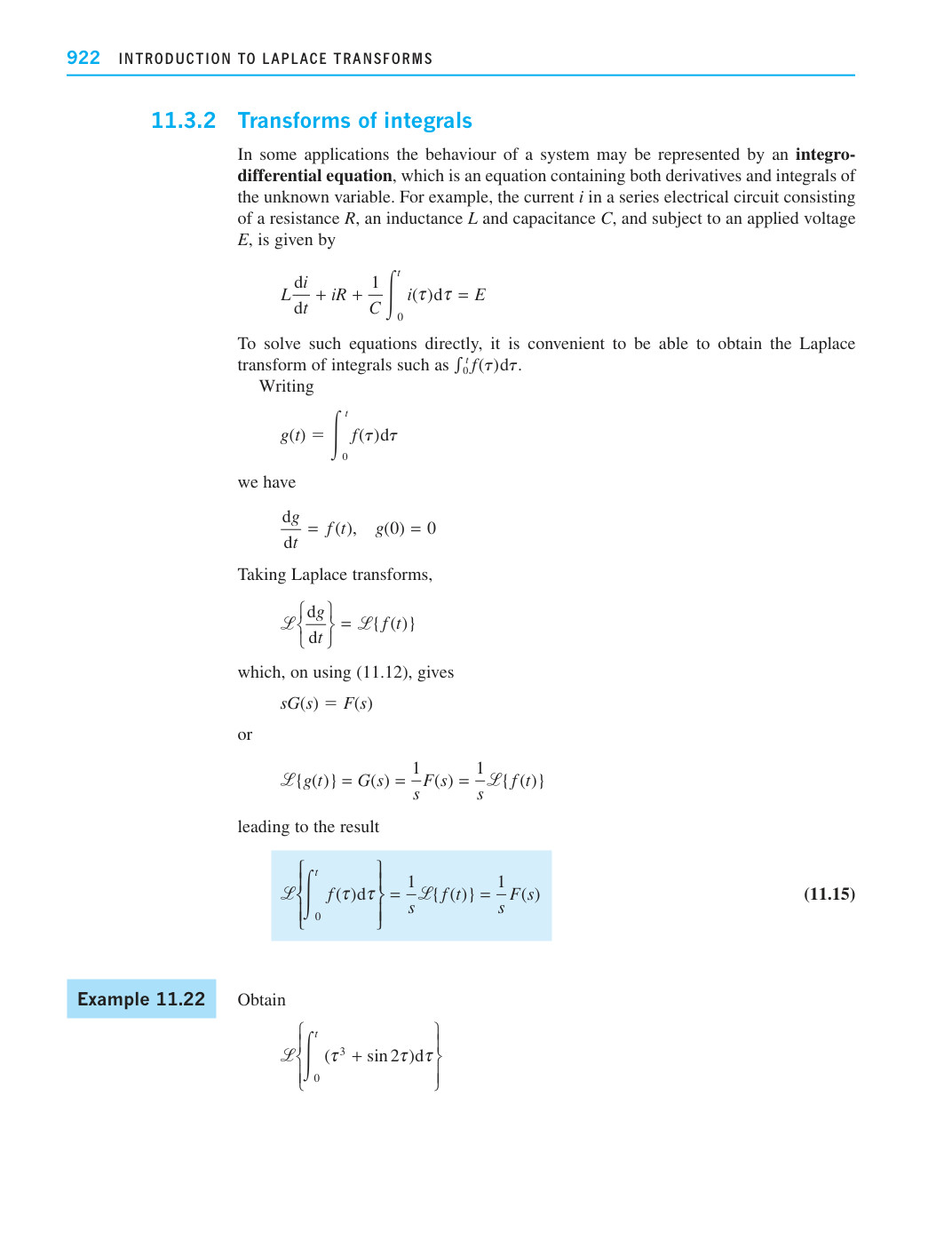
在某些应用中,系统的行为可以用积分微分方程来表示,即同时包含未知变量的导数和积分的方程。例如,由电阻 $i$ 、电感 $R$ 和电容 $L$ 组成的串联电路,在外加电压 $C$ 的作用下,其电流由下式给出 $E$ 为了直接求解这类方程,能够求出诸如
$$L \frac{di}{dt} + iR + \frac{1}{C} \int_0^t i(\tau) d\tau = E$$
这样的积分的拉普拉斯变换是很方便的。
记 $\int_0^t f(\tau) d\tau$ 我们有
$$g(t) = \int_0^t f(\tau) d\tau$$
取拉普拉斯变换,得
$$\frac{dg}{dt} = f(t), \quad g(0) = 0$$
$$\mathcal{L}\left{\frac{dg}{dt}\right} = \mathcal{L}{f(t)}$$
使用 (11.12) 后,得到
$$sG(s) = F(s)$$
或
$$\mathcal{L}{g(t)} = G(s) = \frac{1}{s}F(s) = \frac{1}{s}\mathcal{L}{f(t)}$$
从而得到结果
$$\mathcal{L}\left{\int_0^t f(\tau) d\tau\right} = \frac{1}{s}\mathcal{L}{f(t)} = \frac{1}{s}F(s) \quad (11.15)$$
求
$$\mathcal{L}\left{\int_0^t (\tau^3 + \sin 2\tau) d\tau\right}$$