English · PDF 284
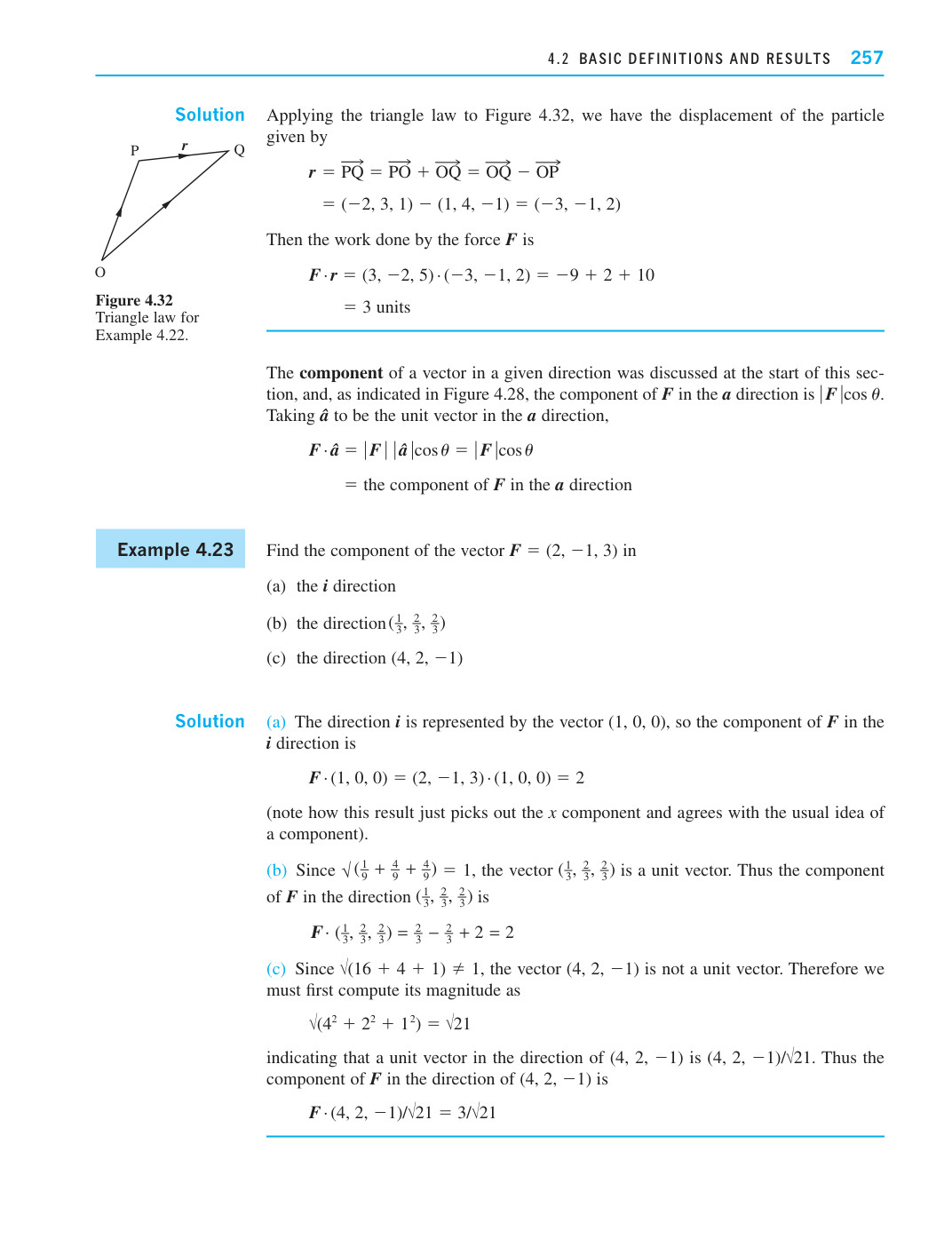
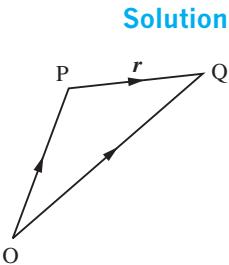
图 4.32
例 4.22 的
三角形法则。
对图 4.32 应用三角形法则,可得该质点的位移为
$$\begin{aligned} \mathbf{r} &= \overrightarrow{PQ} = \overrightarrow{PO} + \overrightarrow{OQ} = \overrightarrow{OQ} - \overrightarrow{OP} \ &= (-2, 3, 1) - (1, 4, -1) = (-3, -1, 2) \end{aligned}$$
那么力所做的功 $\mathbf{F}$ 为
$$\begin{aligned} \mathbf{F} \cdot \mathbf{r} &= (3, -2, 5) \cdot (-3, -1, 2) = -9 + 2 + 10 \ &= 3 \text{ units} \end{aligned}$$
向量在给定方向上的分量已在本节开头讨论过,并且如图 4.28 所示, $\mathbf{F}$ 在 $\mathbf{a}$ 方向上的分量为 $|\mathbf{F}| \cos \theta$ 。取 $\hat{\mathbf{a}}$ 为 $\mathbf{a}$ 方向上的单位向量,
$$\begin{aligned} \mathbf{F} \cdot \hat{\mathbf{a}} &= |\mathbf{F}| |\hat{\mathbf{a}}| \cos \theta = |\mathbf{F}| \cos \theta \ &= \text{the component of } \mathbf{F} \text{ in the } \mathbf{a} \text{ direction} \end{aligned}$$
求向量的分量 $\mathbf{F} = (2, -1, 3)$ in
(a) 该方向 $\mathbf{i}$ 由向量表示 $(1, 0, 0)$ ,所以 $\mathbf{F}$ 在 $\mathbf{i}$ 方向上的分量为
$$\mathbf{F} \cdot (1, 0, 0) = (2, -1, 3) \cdot (1, 0, 0) = 2$$
(注意这个结果恰好选出了 $x$ 分量,并且与通常的分量概念一致)。
(b) 由于 $\sqrt{(\frac{1}{9} + \frac{4}{9} + \frac{4}{9})} = 1$ ,向量 $(\frac{1}{3}, \frac{2}{3}, \frac{2}{3})$ 是单位向量。因此 $\mathbf{F}$ 在方向 $(\frac{1}{3}, \frac{2}{3}, \frac{2}{3})$ 上的分量为
$$\mathbf{F} \cdot (\frac{1}{3}, \frac{2}{3}, \frac{2}{3}) = \frac{2}{3} - \frac{2}{3} + 2 = 2$$
(c) 由于 $\sqrt{(16 + 4 + 1)} \neq 1$ ,向量 $(4, 2, -1)$ 不是单位向量。因此我们必须先计算其大小为
$$\sqrt{(4^2 + 2^2 + 1^2)} = \sqrt{21}$$
,这表明沿该方向的单位向量为 $(4, 2, -1)$ 是 $(4, 2, -1)/\sqrt{21}$ 。因此 $\mathbf{F}$ 在 $(4, 2, -1)$ 方向上的分量是
$$\mathbf{F} \cdot (4, 2, -1)/\sqrt{21} = 3/\sqrt{21}$$