English · PDF 332
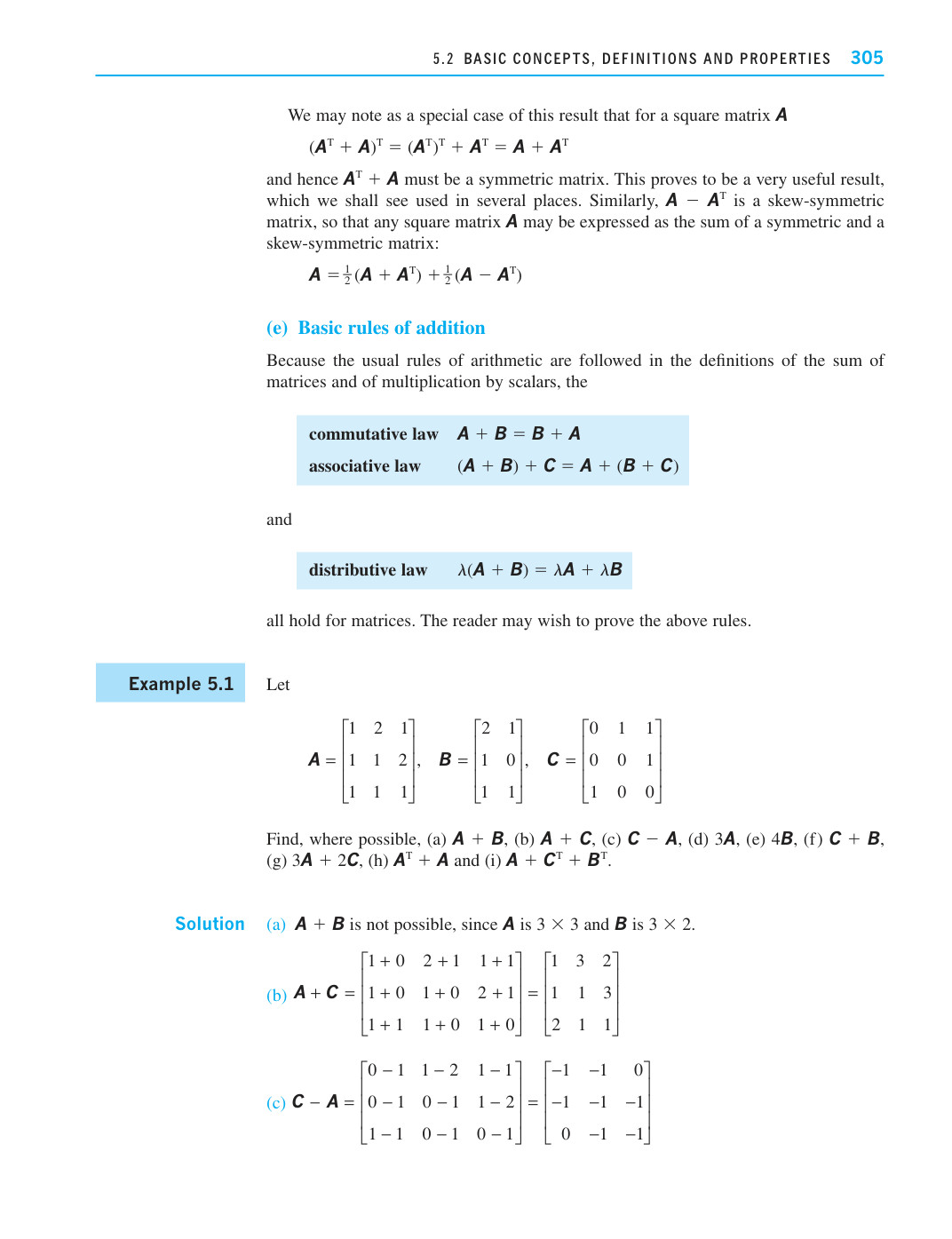
我们可以注意到,作为该结果的一个特例,对于方阵 $\mathbf{A}$
$$(\mathbf{A}^T + \mathbf{A})^T = (\mathbf{A}^T)^T + \mathbf{A}^T = \mathbf{A} + \mathbf{A}^T$$
因此 $\mathbf{A}^T + \mathbf{A}$ 必定是对称矩阵。事实证明这是一个非常有用的结果,我们将在多处看到它的应用。类似地, $\mathbf{A} - \mathbf{A}^T$ 是一个反对称矩阵,因此任何方阵 $\mathbf{A}$ 都可以表示为一个对称矩阵与一个反对称矩阵之和:
$$\mathbf{A} = \frac{1}{2}(\mathbf{A} + \mathbf{A}^T) + \frac{1}{2}(\mathbf{A} - \mathbf{A}^T)$$
由于在矩阵加法及标量乘法的定义中遵循了通常的算术规则,因此
$$\text{commutative law} \quad \mathbf{A} + \mathbf{B} = \mathbf{B} + \mathbf{A}$$
$$\text{associative law} \quad (\mathbf{A} + \mathbf{B}) + \mathbf{C} = \mathbf{A} + (\mathbf{B} + \mathbf{C})$$
和
$$\text{distributive law} \quad \lambda(\mathbf{A} + \mathbf{B}) = \lambda\mathbf{A} + \lambda\mathbf{B}$$
对矩阵均成立。读者可以尝试证明上述规则。
设
$$\mathbf{A} = \begin{bmatrix} 1 & 2 & 1 \ 1 & 1 & 2 \ 1 & 1 & 1 \end{bmatrix}, \quad \mathbf{B} = \begin{bmatrix} 2 & 1 \ 1 & 0 \ 1 & 1 \end{bmatrix}, \quad \mathbf{C} = \begin{bmatrix} 0 & 1 & 1 \ 0 & 0 & 1 \ 1 & 0 & 0 \end{bmatrix}$$
在可能的情况下求 (a) $\mathbf{A} + \mathbf{B}$ , (b) $\mathbf{A} + \mathbf{C}$ , (c) $\mathbf{C} - \mathbf{A}$ , (d) $3\mathbf{A}$ , (e) $4\mathbf{B}$ , (f) $\mathbf{C} + \mathbf{B}$ , (g) $3\mathbf{A} + 2\mathbf{C}$ , (h) $\mathbf{A}^T + \mathbf{A}$ 以及 (i) $\mathbf{A} + \mathbf{C}^T + \mathbf{B}^T$ 。
解答 (a) $\mathbf{A} + \mathbf{B}$ 是不可能的,因为 $\mathbf{A}$ 是 $3 \times 3$ 且 $\mathbf{B}$ 是 $3 \times 2$ .
$$(b) \mathbf{A} + \mathbf{C} = \begin{bmatrix} 1+0 & 2+1 & 1+1 \ 1+0 & 1+0 & 2+1 \ 1+1 & 1+0 & 1+0 \end{bmatrix} = \begin{bmatrix} 1 & 3 & 2 \ 1 & 1 & 3 \ 2 & 1 & 1 \end{bmatrix}$$
$$(c) \mathbf{C} - \mathbf{A} = \begin{bmatrix} 0-1 & 1-2 & 1-1 \ 0-1 & 0-1 & 1-2 \ 1-1 & 0-1 & 0-1 \end{bmatrix} = \begin{bmatrix} -1 & -1 & 0 \ -1 & -1 & -1 \ 0 & -1 & -1 \end{bmatrix}$$