English · PDF 363
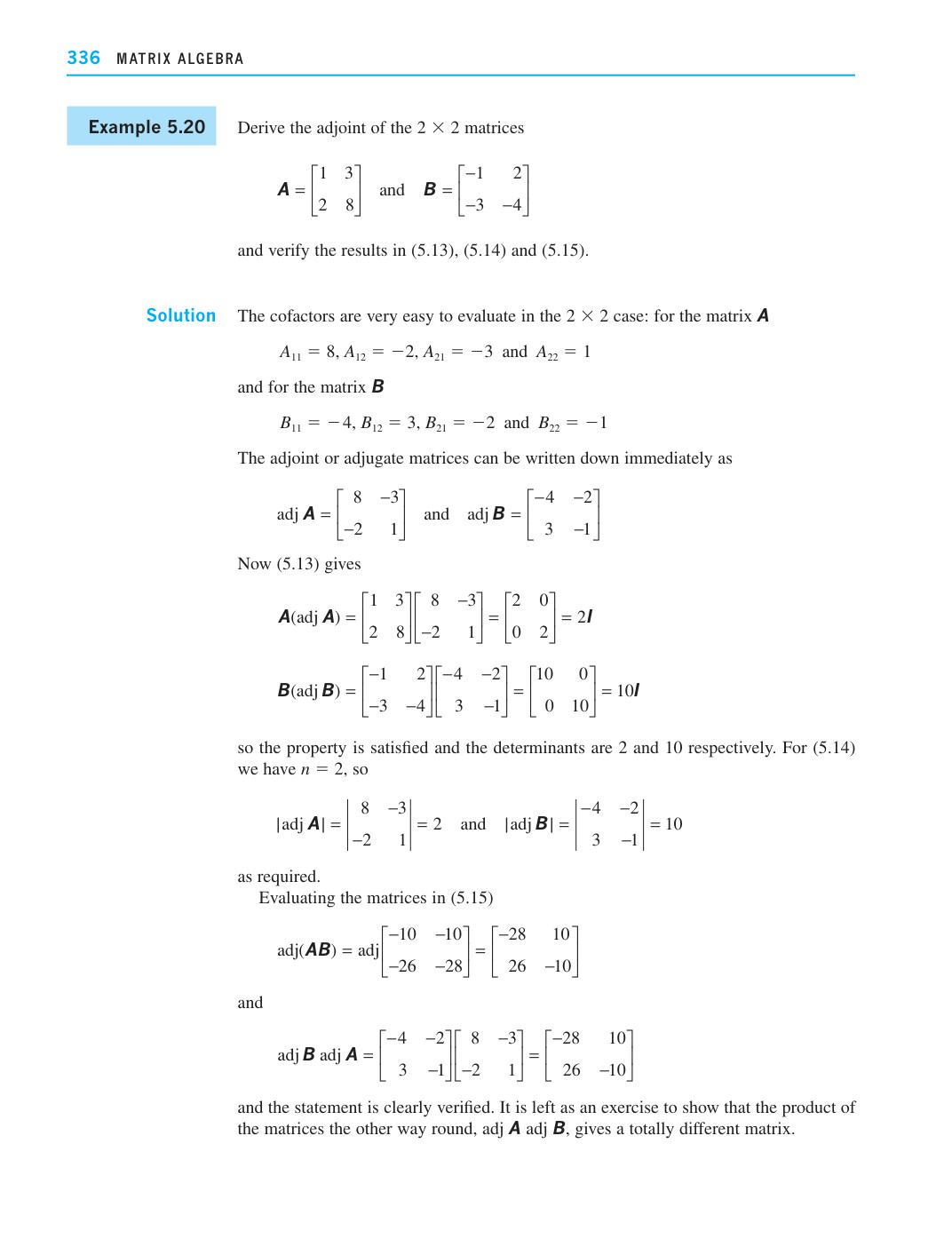
Example 5.20推导……的伴随 $2 \times 2$ matrices
$$\mathbf{A} = \begin{bmatrix} 1 & 3 \ 2 & 8 \end{bmatrix} \quad \text{and} \quad \mathbf{B} = \begin{bmatrix} -1 & 2 \ -3 & -4 \end{bmatrix}$$
并验证结果于 (5.13), (5.14) and (5.15).
Solution 在……中,余子式(代数余子式)非常容易计算 $2 \times 2$ case: 对于矩阵 $\mathbf{A}$
$$A_{11} = 8, A_{12} = -2, A_{21} = -3 \quad \text{and} \quad A_{22} = 1$$
以及对于矩阵 $\mathbf{B}$
$$B_{11} = -4, B_{12} = 3, B_{21} = -2 \quad \text{and} \quad B_{22} = -1$$
伴随矩阵可以立即写出为
$$\text{adj } \mathbf{A} = \begin{bmatrix} 8 & -3 \ -2 & 1 \end{bmatrix} \quad \text{and} \quad \text{adj } \mathbf{B} = \begin{bmatrix} -4 & -2 \ 3 & -1 \end{bmatrix}$$
Now (5.13) gives
$$\mathbf{A}(\text{adj } \mathbf{A}) = \begin{bmatrix} 1 & 3 \ 2 & 8 \end{bmatrix} \begin{bmatrix} 8 & -3 \ -2 & 1 \end{bmatrix} = \begin{bmatrix} 2 & 0 \ 0 & 2 \end{bmatrix} = 2\mathbf{I}$$
$$\mathbf{B}(\text{adj } \mathbf{B}) = \begin{bmatrix} -1 & 2 \ -3 & -4 \end{bmatrix} \begin{bmatrix} -4 & -2 \ 3 & -1 \end{bmatrix} = \begin{bmatrix} 10 & 0 \ 0 & 10 \end{bmatrix} = 10\mathbf{I}$$
所以该性质成立,行列式为 2 and 10 respectively. For (5.14) 我们有 $n = 2$ , so
$$|\text{adj } \mathbf{A}| = \begin{vmatrix} 8 & -3 \ -2 & 1 \end{vmatrix} = 2 \quad \text{and} \quad |\text{adj } \mathbf{B}| = \begin{vmatrix} -4 & -2 \ 3 & -1 \end{vmatrix} = 10$$
根据需要.
计算其中的矩阵 (5.15)
$$\text{adj}(\mathbf{AB}) = \text{adj} \begin{bmatrix} -10 & -10 \ -26 & -28 \end{bmatrix} = \begin{bmatrix} -28 & 10 \ 26 & -10 \end{bmatrix}$$
and
$$\text{adj } \mathbf{B} \text{ adj } \mathbf{A} = \begin{bmatrix} -4 & -2 \ 3 & -1 \end{bmatrix} \begin{bmatrix} 8 & -3 \ -2 & 1 \end{bmatrix} = \begin{bmatrix} -28 & 10 \ 26 & -10 \end{bmatrix}$$
且该命题显然得证. 留给读者作为练习,证明按相反次序相乘所得的矩阵乘积, $\text{adj } \mathbf{A} \text{ adj } \mathbf{B}$ , 给出一个完全不同的矩阵.