English · PDF 372
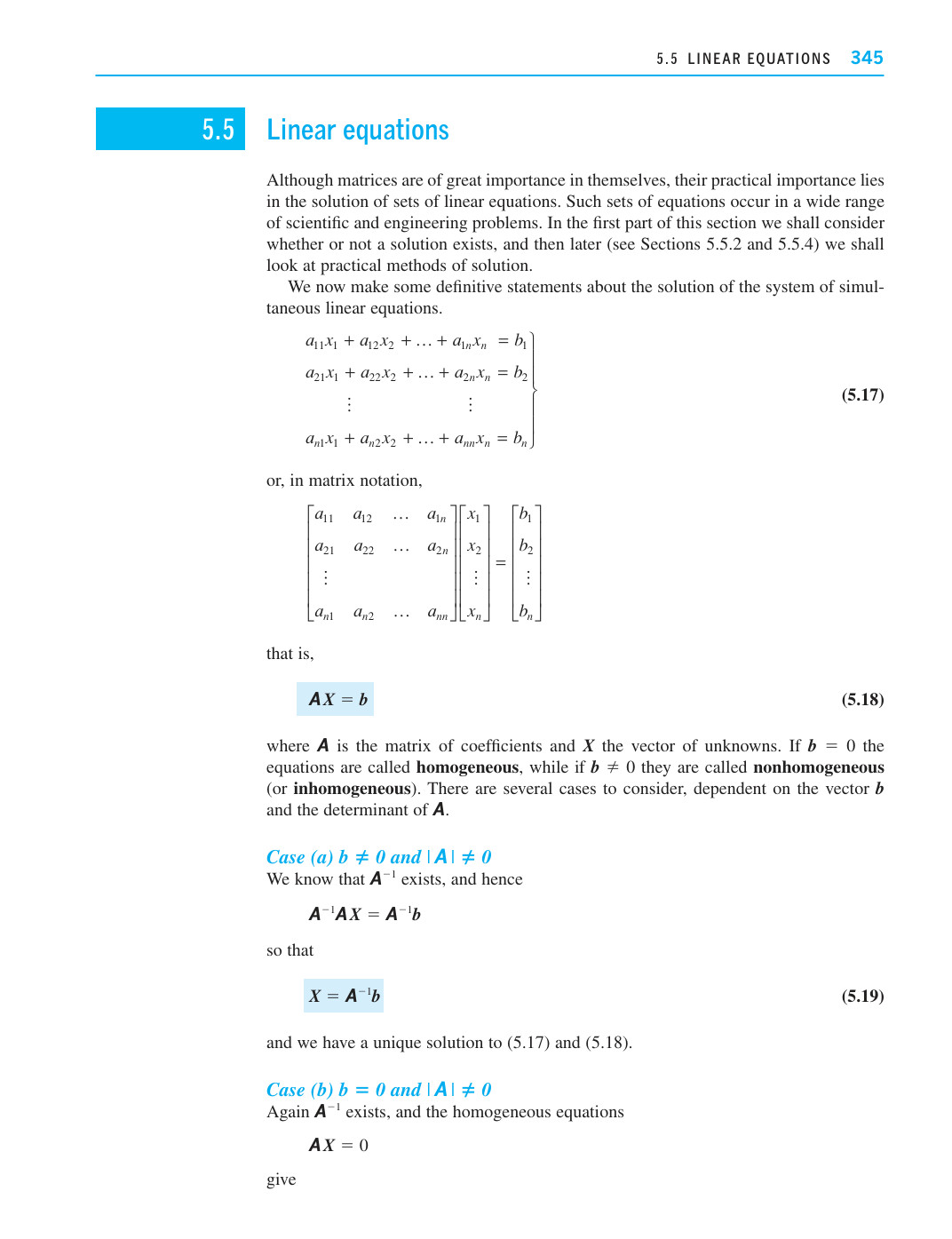
尽管矩阵本身非常重要,但其实际重要性在于求解线性方程组。这类方程组出现在广泛的科学和工程问题中。在本节的第一部分,我们将考虑解是否存在,然后在后面(见 5.5.2 节和 5.5.4 节)我们将讨论实际的求解方法。
现在我们对联立线性方程组的解作一些明确的说明。
$$\left. \begin{aligned} a_{11}x_1 + a_{12}x_2 + \dots + a_{1n}x_n &= b_1 \ a_{21}x_1 + a_{22}x_2 + \dots + a_{2n}x_n &= b_2 \ \vdots &\vdots \ a_{n1}x_1 + a_{n2}x_2 + \dots + a_{nn}x_n &= b_n \end{aligned} \right} \quad (5.17)$$
或者,用矩阵记号表示,
$$\begin{bmatrix} a_{11} & a_{12} & \dots & a_{1n} \ a_{21} & a_{22} & \dots & a_{2n} \ \vdots & \vdots & \ddots & \vdots \ a_{n1} & a_{n2} & \dots & a_{nm} \end{bmatrix} \begin{bmatrix} x_1 \ x_2 \ \vdots \ x_n \end{bmatrix} = \begin{bmatrix} b_1 \ b_2 \ \vdots \ b_n \end{bmatrix}$$
即,
$$\mathbf{A}X = \mathbf{b} \quad (5.18)$$
其中 $\mathbf{A}$ 是系数矩阵, $X$ 是未知数向量。如果 $\mathbf{b} = 0$ 则方程组称为齐次的;如果 $\mathbf{b} \neq 0$ 则称为非齐次的(或非齐性的)。有几种情况需要考虑,取决于向量 $\mathbf{b}$ 以及 $\mathbf{A}$ 的行列式。
情形 $\mathbf{b} \neq 0$ 和 $|\mathbf{A}| \neq 0$
我们知道 $\mathbf{A}^{-1}$ 存在,因此
$$\mathbf{A}^{-1}\mathbf{A}X = \mathbf{A}^{-1}\mathbf{b}$$
从而
$$X = \mathbf{A}^{-1}\mathbf{b} \quad (5.19)$$
并且方程 (5.17) 和 (5.18) 有唯一解。
情形 (b) $\mathbf{b} = 0$ 和 $|\mathbf{A}| \neq 0$
同样 $\mathbf{A}^{-1}$ 存在,且齐次方程组
$$\mathbf{A}X = 0$$