English · PDF 612
解 (a) 引入中间变量 $z = x^2 + 1$ 和 $w = \sin z$ ,则
$$y = w^2, \quad w = \sin z, \quad z = x^2 + 1$$
$$\frac{dy}{dw} = 2w, \quad \frac{dw}{dz} = \cos z, \quad \frac{dz}{dx} = 2x$$
因此由扩展链式法则
$$\frac{dy}{dx} = \frac{dy}{dw} \frac{dw}{dz} \frac{dz}{dx} = (2w)(\cos z)(2x)$$
由于 $z = x^2 + 1$ 和 $w = \sin z = \sin(x^2 + 1)$ ,
$$\frac{dy}{dx} = 4x \sin(x^2 + 1) \cos(x^2 + 1)$$
由于 $z = x^2 + 1$ 和 $w = \sin z = \sin(x^2 + 1)$ ,
$$\frac{dy}{dx} = 4x \sin(x^2 + 1) \cos(x^2 + 1)$$ (b) 引入中间变量 $z = 1 - x^2$ 和 $w = \sqrt{z}$ , 然后
$$y = \cos^{-1} w $$y = \cos^{-1}w, \quad w = z^{1/2}, \quad z = 1 - x^2$$
$$y = \cos^{-1}w, \quad w = z^{1/2}, \quad z = 1 - x^2$$
$$\frac{dy}{dw} = -\frac{1}{\sqrt{(1-w^2)}}, \quad \frac{dw}{dz} = \frac{1}{2}z^{-1/2}, \quad \frac{dz}{dx} = -2x$$
Since $z = 1 - x^2$ and $w = \sqrt{(1 - x^2)}$ we have, by the extended chain rule,
Since $$z = 1 - x^2$$ and $w = \sqrt{(1 - x^2)}$ we have, by the extended chain rule, $$\frac{dy}{dx} = \frac{dy}{dw} \frac{dw}{dz} \frac{dz}{dx} = \left( -\frac{1}{\sqrt{[1 - (1 - x^2)]}} \right) \left( \frac{1}{2\sqrt{(1 - x^2)}} \right) (-2x) = \frac{1}{\sqrt{(1 - x^2)}}$$ Here we have assu
Here we have assumed $0 < x < 1$ . If $-1 < x < 0$ the derivative is $-1/\sqrt{(1 - x^2)}$ . The function has no derivative at $x = 0$ . This is illustrated in Figure 8.24.
For practice, use MATLAB to check the answers to Examples 8.17 and 8.18. As illustrative examples we consider Examples 8.17(c and h) and Example 8.18(a). For Example 8.17(c) the MATLAB commands
syms x y y = sin(2*x)/(x^2 + 2); dy = simplify(diff(y)); pretty(dy)
$$dy = 2 \frac{2 \cos(2x) + \cos(2x) x^2 - \sin(2x) x}{(2 + x^2)^2}$$
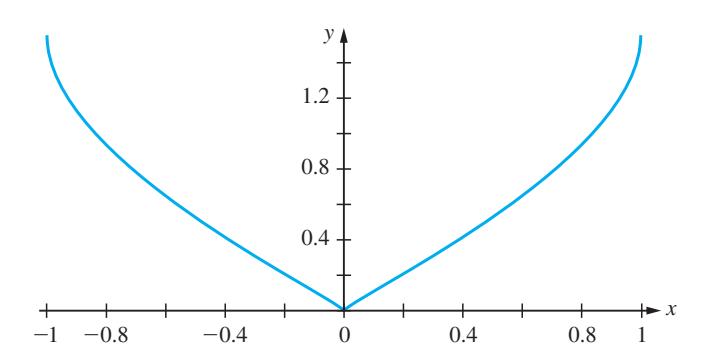

Figure 8.24 Graph of $y = \cos^{-1}(1 - x^2)$ .$$