English · PDF 634
解 导数为
$$f'(x) = 12x^2 - 42x + 18 = 6(2x - 1)(x - 3)$$
驻点出现在 $f'(x) = 0$ ;即
$$6(2x - 1)(x - 3) = 0$$
其解为 $x = \frac{1}{2}$ 和 $x = 3$ 。函数对应的函数值为
$$f(\frac{1}{2}) = 4(\frac{1}{8}) - 2l(\frac{1}{4}) + 18(\frac{1}{2}) + 6 = \frac{41}{4}$$
和
$$f(3) = 4(27) - 21(9) + 18(3) +6) = -21$$
因此 的驻点为 $f(x)$ 和
$$(\frac{1}{2}, \frac{41}{4})$$ 和 $(3, -21)$
为了研究它们的性质,我们使用上面概述的步骤。
(a) 考虑点 $(\frac{1}{2}, \frac{41}{4})$ :如果 $x$ 略小于 $\frac{1}{2}$ ,则 $2x - 1 < 0$ 且 $x - 3 < 0$ ,因此
$$f'(x) = 6(2x - 1)(x - 3) = (\text{negative})(\text{negative}) = (\text{positive})$$
而如果 $x$ 略大于 $\frac{1}{2}$ ,则 $2x - 1 > 0$ 且 $x - 3 < 0$ , 所以
$$f'(x) = (\text{positive})(\text{negative}) = (\text{negative})$$
因此 $f'(x)$ 当我们经过该点时,它从(正)变为(负),所以 $(\frac{1}{2}, \frac{4}{4})$ 是一个局部最大值。
(b) 考虑点 $(3, -21)$ :如果 $x$ 略小于 3,那么 $2x - 1 > 0$ 且 $x - 3 < 0$ ,所以
$$f'(x) = (\text{positive})(\text{negative}) = (\text{negative})$$
而如果 $x$ 略大于 3,那么 $2x - 1 > 0$ 和 $x - 3 > 0$ ,使得
$$f'(x) = (\text{positive})(\text{positive}) = (\text{positive})$$
因此 $f'(x)$ 在经过该点时从(负)变为(正),所以 (3, -21) 是一个局部最小值。
现在可以利用这些信息来绘制 $f(x)$ 的图像,如图 8.34 所示。
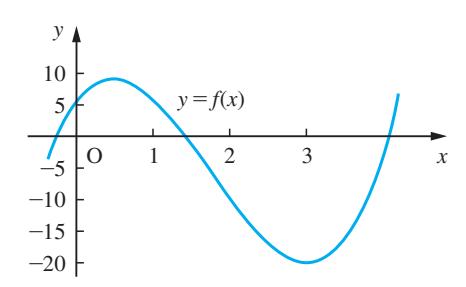
图 8.34
图像 $f(x) =$
$4x^3 - 21x^2 + 18x + 6$ .